
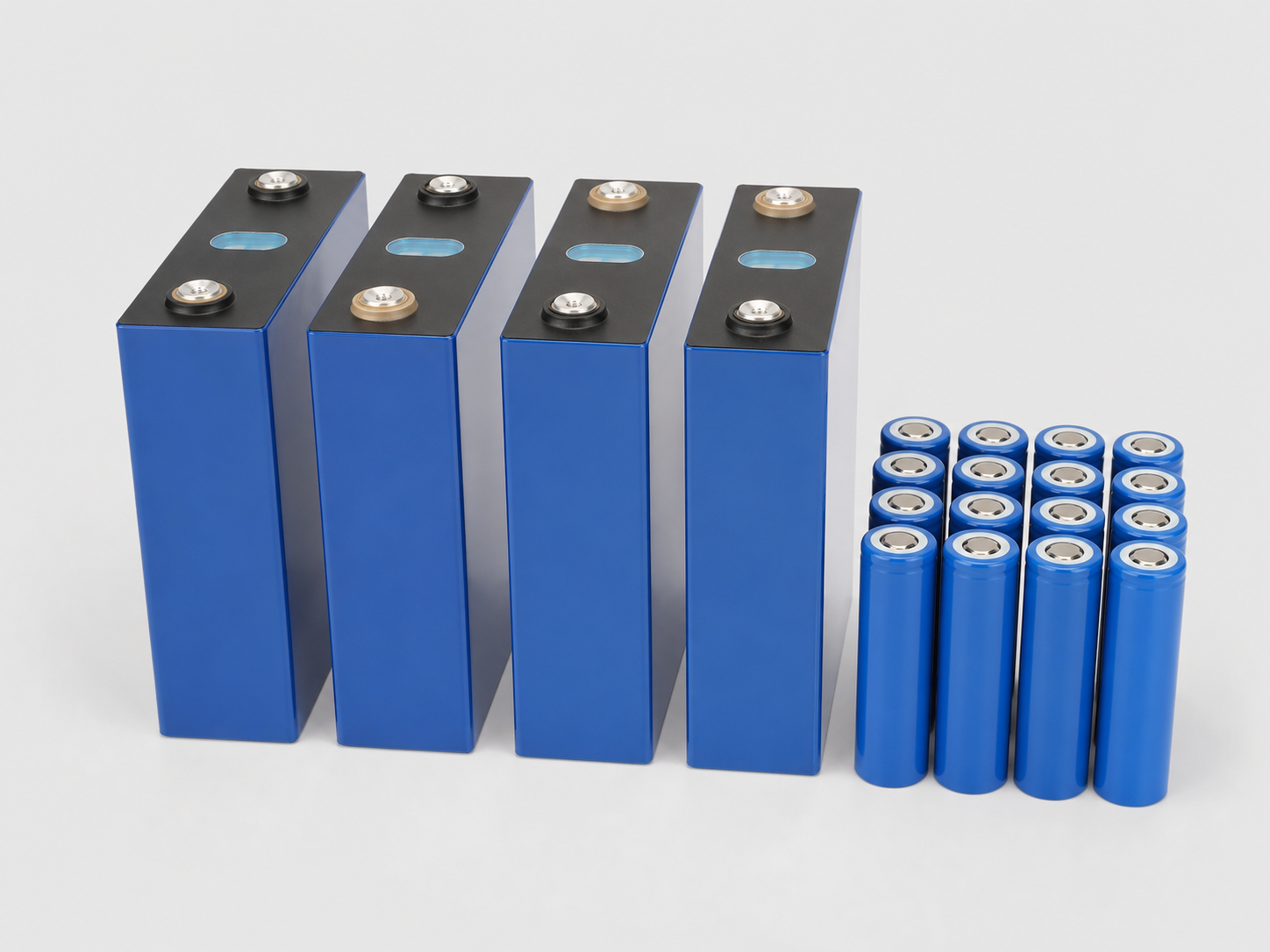
Short answer: LiFePO4 is widely selected for stationary and mobile energy storage because of its thermal stability and long service potential. Other lithium-ion chemistries can offer higher energy density, which is valuable where size and weight are critical. The correct choice depends on the full system, not chemistry alone.
Key differences
| Design factor | LiFePO4 | Other common lithium-ion cells |
|---|---|---|
| Nominal cell voltage | About 3.2 V | Often about 3.6-3.7 V |
| Energy density | Generally lower | Generally higher |
| Thermal stability | Strong advantage | Depends on chemistry and cell design |
| Typical priority | Cycle life, safety margin and stationary storage | Compact size, lower weight or high power |
Values vary by manufacturer and cell model. Always compare official datasheets and test conditions rather than using chemistry-level assumptions as final design limits.
When LiFePO4 is a strong fit
- Home solar storage and backup systems
- RV, marine and off-grid auxiliary power
- Applications that prioritize cycle life over minimum weight
- Modular systems designed around 12.8 V, 25.6 V or 51.2 V nominal packs
When higher-energy lithium-ion cells may fit
- E-bikes and mobility products with strict space limits
- Portable equipment where weight is critical
- High-power packs using a cell model designed for the required current
System components still matter
Cell chemistry is only one layer of safety and performance. A complete system also depends on cell matching, mechanical protection, fusing, busbars, temperature monitoring, charger settings, BMS configuration, enclosure ventilation and installation quality.
Explore LiFePO4 cells, LiFePO4 battery packs and DIY battery components.
Frequently asked questions
Is LiFePO4 the same as every lithium-ion battery?
LiFePO4 is one lithium-ion chemistry with a different nominal voltage and performance profile from chemistries commonly used in cylindrical high-energy cells.
Can a lithium-ion charger be used for LiFePO4?
Only when the charger is explicitly designed and configured for the exact LiFePO4 series count and voltage limits. Incorrect charging settings can be hazardous.
Which chemistry lasts longer?
LiFePO4 often has a cycle-life advantage, but actual life depends on the specific cell, depth of discharge, temperature, charge rate, discharge rate and operating limits.