
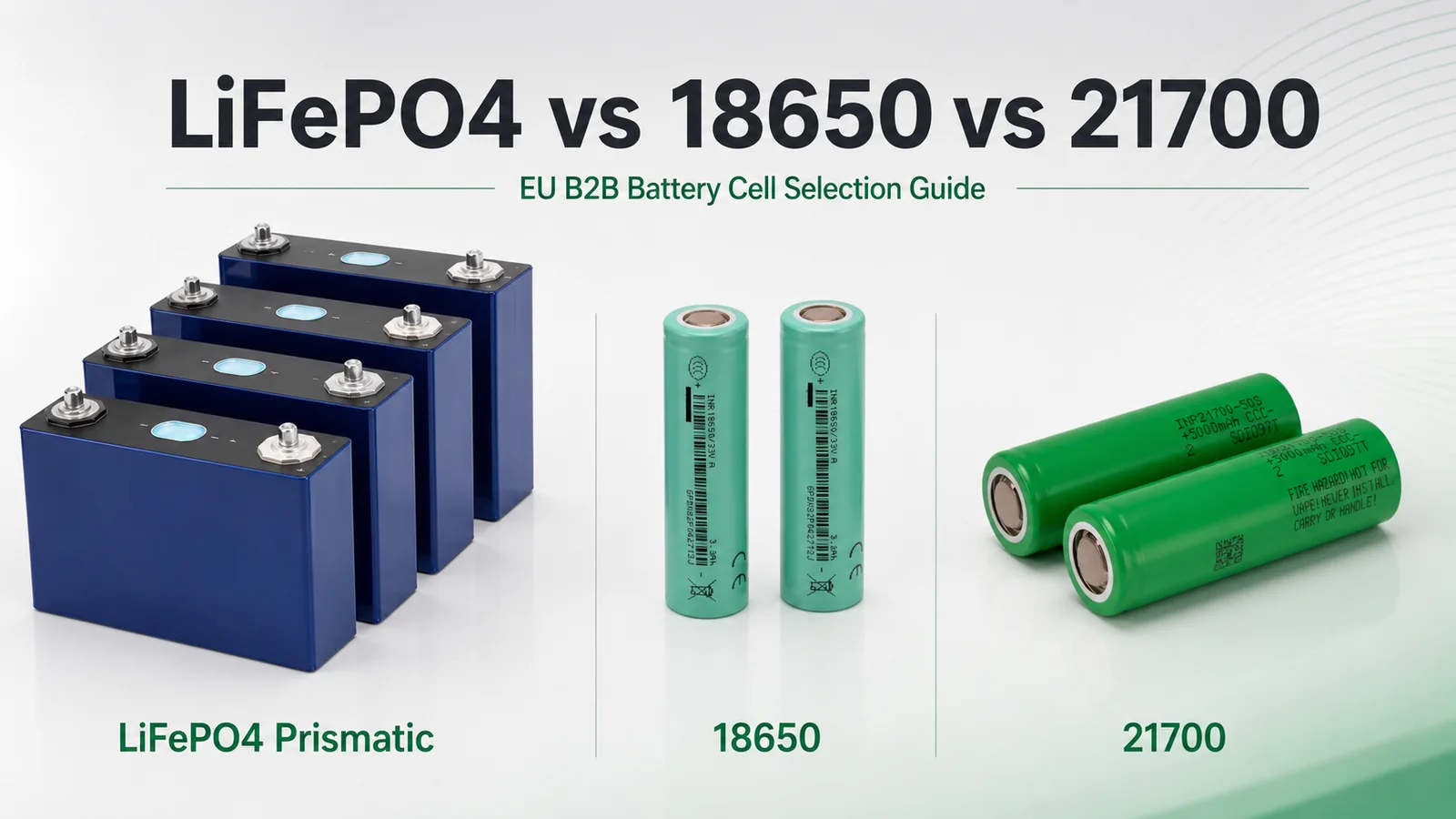
Choosing a battery cell is not simply a matter of selecting the highest capacity. For a European B2B project, the correct choice depends on the electrical design, available installation space, discharge requirement, cycle-life target, thermal strategy, documentation needs and delivery destination.
LiFePO4 prismatic cells, 18650 lithium-ion cells and 21700 lithium-ion cells serve different project requirements. Before requesting a quotation, buyers should define the application and confirm the exact model rather than treating cells of the same format as interchangeable.
Quick comparison
| Cell type | Typical strengths | Common project uses | Key points to confirm |
|---|---|---|---|
| LiFePO4 prismatic | Long cycle-life focus, large single-cell capacity and simplified pack layouts | Stationary energy storage, industrial systems and low-speed mobility | Dimensions, terminal design, capacity, continuous current and required documents |
| 18650 lithium-ion | Compact cylindrical format with many established models | Power tools, portable equipment, medical devices and compact battery packs | Exact model, chemistry, capacity, discharge capability and pack configuration |
| 21700 lithium-ion | Larger cylindrical format with higher capacity potential per cell | E-bikes, mobility systems, tools, robotics and higher-energy cylindrical packs | Capacity, current demand, thermal design, dimensions and model availability |
This table is a starting point only. The final selection must be checked against the cell manufacturer’s current datasheet and the requirements of the complete battery system.
When should a project consider LiFePO4 prismatic cells?
LiFePO4 prismatic cells are commonly considered when a project needs a large-format cell for energy storage or an industrial battery system. Their rectangular shape can reduce the number of parallel cells required in a high-capacity pack, but the mechanical design must control compression, spacing, busbar layout and terminal loading correctly.
Buyers should confirm more than nominal capacity. The required information normally includes nominal voltage, cell dimensions, weight, continuous charge and discharge current, operating temperature range, terminal specification and the current manufacturer datasheet.
Model numbers matter. Two LiFePO4 cells with similar capacity labels may have different dimensions, terminal arrangements or operating limits. Review the LiFePO4 prismatic cell model selection guide before choosing a cell for a new pack design.
When is the 18650 format suitable?
The 18650 format remains useful for compact cylindrical battery packs and applications with established mechanical platforms. It can support flexible series-parallel configurations, but cell count, welding design and quality-control requirements increase as the pack becomes larger.
An 18650 model should be selected using the exact manufacturer designation. Capacity alone does not describe its intended use. A high-capacity energy cell and a high-power cell may have different current limits and thermal behavior even when their dimensions are identical.
For procurement, confirm the brand, exact model, nominal capacity, nominal voltage, required current and intended application. The 18650 battery cell model selection guide provides a structured way to compare available model information.
When should buyers evaluate 21700 cells?
The 21700 format offers a larger cylindrical cell than the 18650 format. Depending on the exact model, it may help reduce the number of cells needed for a defined pack capacity. This does not automatically make every 21700 cell suitable for high-power use.
For an e-bike, power tool, robotics platform or industrial pack, the designer should calculate the continuous and peak current required from each parallel group. The selected cell must then be checked against the manufacturer’s documented operating limits and the pack’s thermal design.
Buyers should also check whether an existing 18650 enclosure, holder or welding process can accommodate the larger 21700 dimensions. Use the 21700 battery cell model selection guide to organize capacity, current and application requirements before requesting supply confirmation.
Five questions to answer before requesting a quotation
1. What is the application?
State whether the cells will be used in stationary storage, e-bikes, mobility systems, tools, robotics, backup power or another product. The application helps identify whether the design is primarily energy-focused, power-focused or cycle-life-focused.
2. What exact cell or target specification is required?
Provide the manufacturer and model whenever possible. If the model has not been selected, provide the required chemistry, format, capacity range, voltage, continuous current, dimensions and operating conditions.
3. What quantity is required?
Separate sample requirements from production requirements. Sample availability, minimum order quantity and production supply should be confirmed for the exact model instead of assumed from another product.
4. What is the delivery country?
The destination affects the delivery route and the information required for a shipment quotation. EU warehouse availability should be confirmed by cell model, quantity and destination country for each inquiry. A warehouse page should not be interpreted as a guarantee that every model is continuously in stock.
See the current European warehouse and delivery information for the confirmation process.
5. Which technical or shipment documents are required?
Tell the supplier which documents your company needs for technical review, transport planning or internal approval. Document availability must be checked for the exact brand and model. Do not assume that documentation for one cell automatically applies to another model.
Translate the pack requirement into a cell requirement
Buyers obtain better results when the inquiry starts with the battery-system requirement rather than a capacity label copied from another project. Define the pack’s nominal voltage, usable energy, continuous power and expected peak load. The engineering team can then estimate the required series and parallel configuration and determine the current demanded from each cell.
For example, increasing the number of cells in parallel can reduce the current carried by each cell, but it also changes the cell count, interconnection design, enclosure size and quality-control workload. Selecting a cell with a higher capacity may reduce cell count, yet it may not satisfy the project’s peak-current or thermal requirements. These trade-offs must be reviewed together.
The following inputs are useful during technical matching:
- Target pack voltage and usable energy
- Continuous and peak power demand
- Maximum acceptable dimensions and weight
- Expected charge and discharge temperature range
- Required service life or cycle target
- Cooling method and available thermal-monitoring points
- Existing holder, busbar, welding or compression constraints
Cell selection should be completed by the responsible battery-system designer. A supplier can help organize model information, but the final pack design, protection strategy and validation remain project-specific engineering responsibilities.
Energy cells and power cells are not interchangeable
Capacity and discharge capability describe different aspects of a cell. An energy-oriented model may be designed to store more energy, while a power-oriented model may prioritize current delivery and thermal performance. Choosing solely by the largest ampere-hour value can therefore produce the wrong result.
For cylindrical cells, buyers should compare the required current per cell with the documented continuous and applicable pulse limits of the exact model. For LiFePO4 prismatic cells, the same principle applies: capacity, charge rate, discharge rate and thermal conditions must all match the system design.
Marketing descriptions such as “high power” are not a substitute for a current manufacturer datasheet. Model-specific documentation should be reviewed before samples are approved or mechanical tooling is finalized.
Why mechanical integration matters
Electrical compatibility alone does not make a cell suitable. A change in diameter, height, terminal design or weight can affect the enclosure, cell holders, busbars, insulation, welding parameters and service access.
Prismatic cells require a mechanical layout appropriate for their specified installation and compression requirements. Cylindrical packs require consistent cell positioning, insulation and interconnection quality across a much larger number of individual cells. In both cases, the pack must allow the battery-management and thermal systems to detect and control abnormal conditions.
Before changing from one model to another, check:
- Cell dimensions and production tolerances
- Positive and negative terminal geometry
- Holder, spacer and insulation compatibility
- Busbar or nickel-strip design
- Welding or fastening process
- Enclosure clearance and ventilation
- Pack-level vibration and transport requirements
Treating a “similar” cell as a drop-in replacement without this review can create redesign work later in the project.
A practical sample-validation process
Samples should be used to confirm more than appearance. A structured validation process helps a buyer determine whether the selected model fits the electrical and mechanical design before a larger order is planned.
Step 1: Confirm identity and documentation
Record the exact brand, model designation and available traceability information. Compare the supplied model with the current datasheet used by the engineering team.
Step 2: Inspect mechanical compatibility
Measure the relevant dimensions and confirm terminal or holder compatibility. Check that the planned insulation and interconnection methods can be implemented consistently.
Step 3: Perform controlled electrical evaluation
Use appropriate test equipment and a documented test plan to evaluate the characteristics required by the project. Testing should be conducted by qualified personnel under controlled conditions.
Step 4: Build and validate the representative system
Cell-level results do not replace pack-level validation. The final design must be evaluated with its battery-management system, protection devices, enclosure, thermal design and intended operating profile.
Step 5: Freeze the approved model
Once validation is complete, record the approved manufacturer and exact model in the purchasing specification. Any proposed substitution should trigger a documented technical review rather than an automatic replacement.
Documents to discuss before shipment planning
Document requirements vary by model, supplier, shipment route and customer procedure. Buyers should state their requirements early so availability can be checked before the order process advances.
Depending on the exact product and transaction, the discussion may include a current technical datasheet, safety-related documentation, transport test information or other documents requested by the buyer’s logistics and compliance teams. This article does not claim that every document is available for every listed model.
The buyer should also confirm that model names are consistent across the quotation, datasheet, packing information and internal purchasing records. Small naming differences can create confusion during technical review and incoming inspection.
Reduce supply and redesign risk
For a production project, the cheapest unit price is not the only procurement consideration. A model change can affect testing, tooling, certification work, pack firmware parameters and warranty risk. Buyers should therefore evaluate the cost of redesign alongside the cell quotation.
A practical sourcing review asks:
- Is the exact manufacturer and model clearly identified?
- Has the design been validated with that model?
- Can the required quantity and destination be checked before ordering?
- Are required documents confirmed for the same model?
- What happens if a substitution is proposed?
- Does the purchasing record preserve the approved specification?
Where continuity is important, discuss forecast quantities and purchasing intervals without assuming guaranteed future stock. A supplier can confirm the current position for a specific inquiry, while the buyer retains an approved change-control process for future supply decisions.
Recommended B2B procurement workflow
An efficient battery-cell procurement process can be organized into seven stages:
- Define the application and pack-level requirement.
- Shortlist exact cell models using current manufacturer information.
- Submit the model, sample quantity, destination and document requirements.
- Review the supplier’s model-specific response.
- Test samples and validate the representative battery system.
- Freeze the approved model and purchasing specification.
- Request production supply and delivery confirmation for the required quantity.
This workflow reduces repeated quotations and prevents a purchasing decision from being separated from the engineering decision that supports it.
What information is needed for a battery-cell wholesale quotation?
A useful wholesale inquiry includes four minimum items: the exact cell model or target specification, required quantity, destination country and requested technical or shipment documents. Application details and expected purchasing schedule can further improve the accuracy of the response.
This information allows the supplier to check model suitability, availability, documentation and delivery options without making unsupported assumptions.
Can EU warehouse availability be confirmed before ordering?
Yes, availability can be checked for a specific inquiry, but it should be confirmed using the exact model, quantity and delivery destination. Stock position and delivery planning can change, so buyers should request a current confirmation instead of relying on a general warehouse statement.
Which cell format is best?
There is no universal best format. LiFePO4 prismatic cells are often evaluated for large-capacity storage and industrial systems. The 18650 format remains relevant for compact and established cylindrical designs. The 21700 format can support newer cylindrical packs requiring greater capacity per cell. The correct choice is the model that satisfies the complete pack’s electrical, mechanical, thermal, safety and documentation requirements.
Request technical matching for your project
SuFeng New Energy supports B2B inquiries for LiFePO4 prismatic cells and 18650/21700 lithium-ion cells. To request technical matching or a wholesale quotation, provide:
- Cell model or target specification
- Required quantity
- Application
- Destination country
- Required technical or shipment documents
Submit these details through the battery cell wholesale inquiry page or the contact page. Availability, documents and delivery conditions will be confirmed for the specific inquiry.