
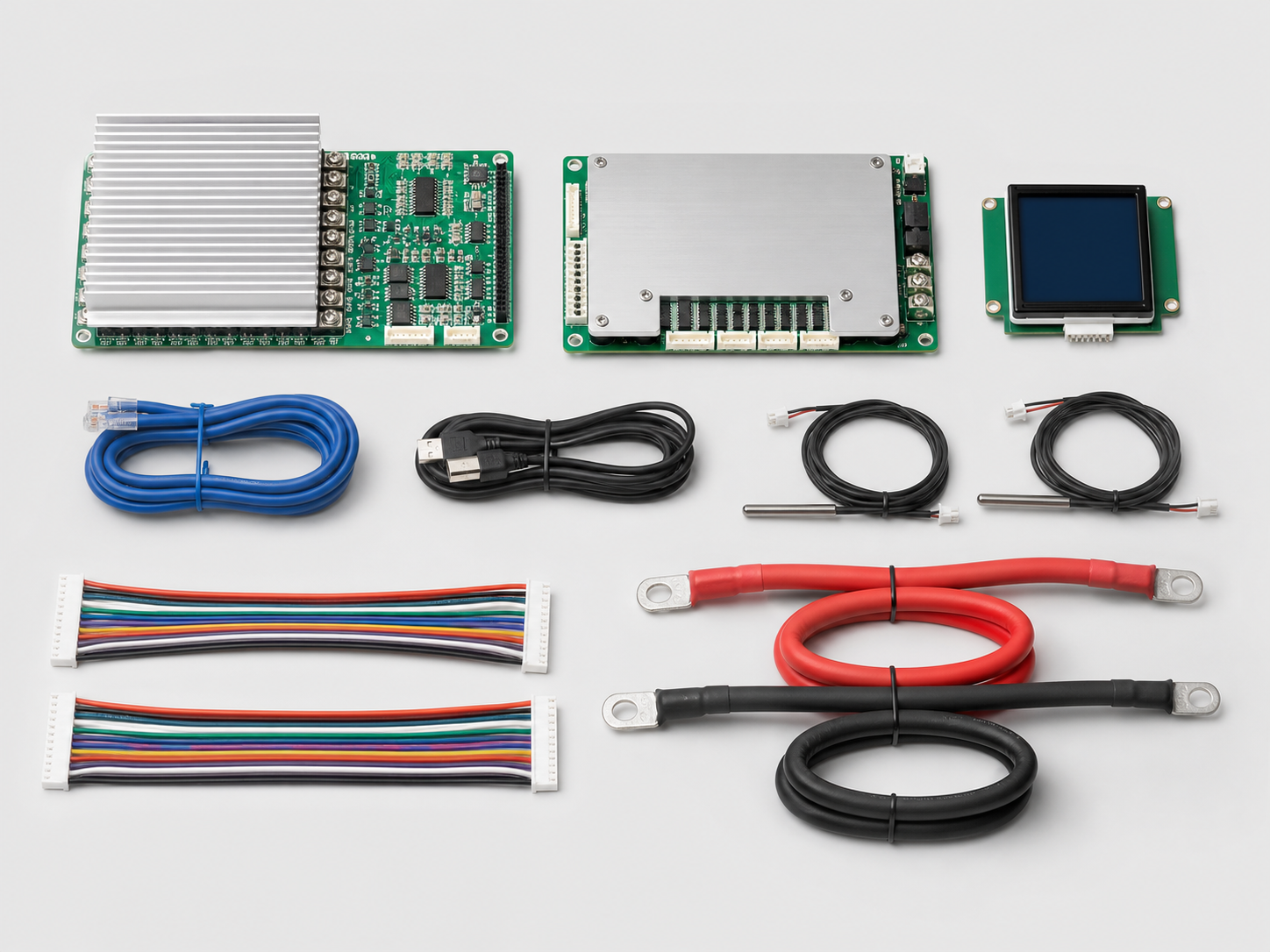
Short answer: a common 51.2 V LiFePO4 battery uses 16 cells in series and therefore needs a 16S LiFePO4 BMS. The BMS must also support the pack’s continuous and peak current, charge current, temperature sensors, balancing requirements and any required CAN, RS485 or Bluetooth communication.
Start with chemistry and series count
A BMS must be configured for the correct chemistry and number of series cells. A 13S lithium-ion BMS is not a substitute for a 16S LiFePO4 BMS. Confirm cell-level charge and discharge limits from the exact cell datasheet before setting protection thresholds.
| Pack description | Typical configuration | Nominal voltage |
|---|---|---|
| 48 V-class lithium-ion | 13S | About 46.8 V |
| 51.2 V LiFePO4 | 16S | 51.2 V |
Size the current rating
The BMS continuous-current rating must cover the real continuous load with suitable engineering margin and at the expected enclosure temperature. Also check short-duration surge current for motors or inverters, maximum charge current and the thermal limits of the BMS conductors and switching devices.
Protection and monitoring features
- Cell overvoltage and undervoltage protection
- Charge and discharge overcurrent protection
- Short-circuit protection
- Low- and high-temperature charge protection
- High-temperature discharge protection
- Cell balancing and balance-current specification
- Pack current, voltage and state monitoring
Communication requirements
CAN or RS485 may be required when the BMS communicates with an inverter, charger or display. A physical connector does not guarantee protocol compatibility. Confirm the protocol, message mapping, baud rate and supported equipment model before purchase.
BMS selection checklist
- Confirm LiFePO4 chemistry and 16S series count.
- List continuous load, surge load and charge current.
- Confirm temperature sensors and protection thresholds.
- Choose passive or active balancing appropriate to the design.
- Verify CAN, RS485, Bluetooth or display compatibility.
- Check conductor, fuse, contactor and pre-charge requirements.
- Validate the complete system before service.
Review our BMS and accessories, learn how many cells are used in a 48 V battery pack, or compare complete LiFePO4 battery packs.
Frequently asked questions
Can I use a 100 A BMS with a 100 A inverter load?
Do not assume the nameplate ratings are sufficient. Review continuous load, surge current, ambient temperature, cooling and the BMS manufacturer’s test conditions, then include suitable design margin.
Does every 16S BMS work with LiFePO4?
No. It must support LiFePO4 voltage limits and the required current, sensors, balancing and communication.
Is Bluetooth enough for inverter communication?
No. Bluetooth is commonly used for monitoring. Inverter integration may require a compatible CAN or RS485 protocol.